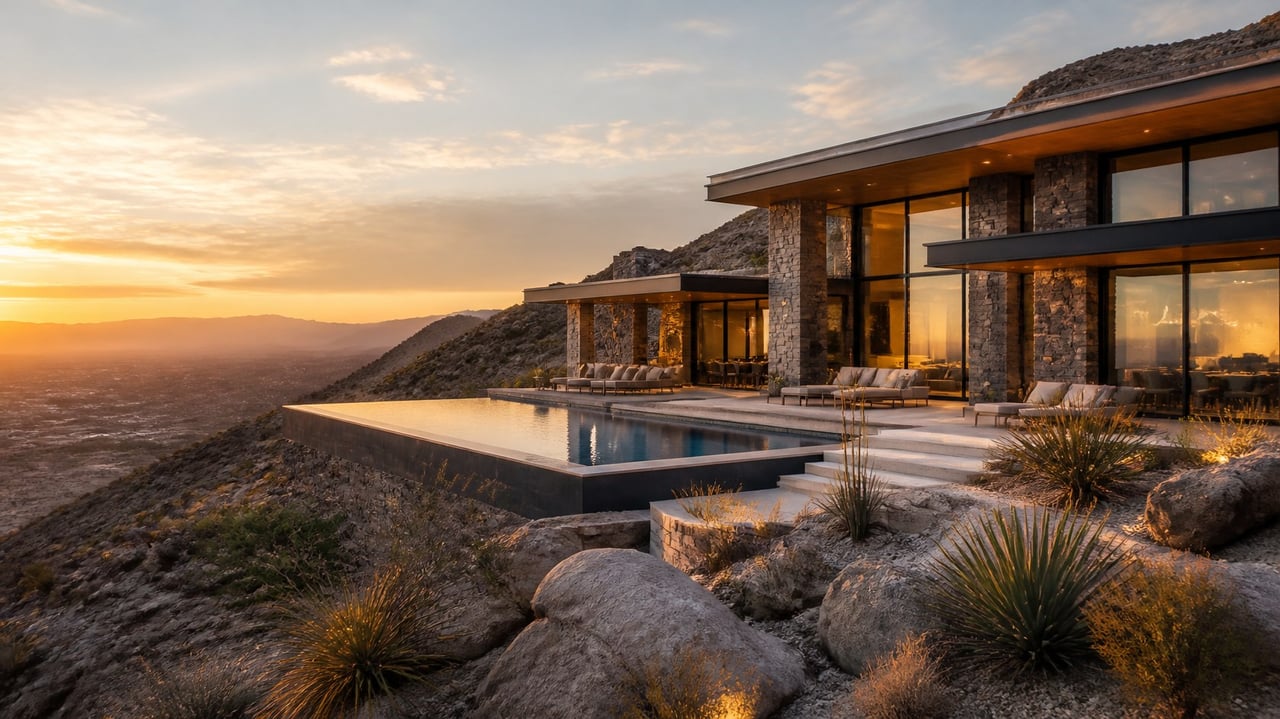
Selling a Blue Heron Las Vegas home requires more than a list of rooms and finishes. Blue Heron's design-led architecture, relationship to the desert, and setting in communities such as MacDonald Highlands. Lake Las Vegas, or Ascaya can shape the way qualified buyers understand the property. The right seller strategy turns those details into a clear, documented story without overstating what the home offers.
Schedule a private Blue Heron home-selling consultation
Why does Blue Heron Las Vegas provenance matter when you sell?
Provenance gives buyers context, but verified property details must lead the story.
A Blue Heron home should be positioned as a considered architectural experience, not as a generic luxury property. Blue Heron's public materials describe a full-service architecture, interior design, and construction firm whose Vegas Modern approach is shaped by Las Vegas climate, landscape, and lifestyle. That context gives sellers a useful starting point, but the marketing must remain specific to the individual residence.
In practical terms, provenance means documenting what is known rather than relying on a brand name alone. Buyers and their advisors may want to understand:
- The Blue Heron community, collection, or design relationship associated with the home
- The original plans, architect or designer records, and material selections available to the seller
- Permitted improvements, remodel dates, warranties, and service records
- The home's orientation, views, outdoor areas, and connection between interior and exterior spaces
- Any community, association, or architectural guidelines that affect use, modifications, or future work
This is not about presenting every home as interchangeable with a new construction release. A completed residence has its own ownership history, maintenance record, upgrades, and daily-life advantages. A credible listing narrative separates verified Blue Heron characteristics from features that are unique to the property.
What should a seller document before marketing a Blue Heron home?
A complete property file makes the listing more accurate and the buyer review more efficient.
Before photography or pricing discussions, assemble a property file that lets the listing team distinguish original design intent from later changes. This makes the marketing more accurate and gives serious buyers a cleaner path through due diligence.
Build a design and improvement file
Gather plans, builder or design correspondence, appliance and mechanical records, receipts for major improvements, warranties, permits, and information about any transferable service agreements. If the home includes custom stone, millwork, lighting, smart-home components, water features, or landscape work, record the installer, date, and care requirements when that information is available.
Do not assume a feature is transferable or covered simply because it appears high-end. Confirm what can be represented, what documentation exists, and what a buyer will receive at closing. This discipline is especially important for a property whose value depends partly on craftsmanship and integration.

Separate community facts from property facts
MacDonald Highlands, Lake Las Vegas, Ascaya, and other Nevada settings each create a different context for a luxury sale. A community page may describe broad amenities, access, or design standards. But a listing should identify only the features that apply to the subject home and its current ownership.
For example, a home near MacDonald Highlands may be positioned around elevation, views, and indoor-outdoor design. While a Lake Las Vegas property may emphasize waterfront or resort-adjacent living if those features are actually present. A residence in or near Ascaya should be described using verified community and property details, not assumptions borrowed from another home. The customer site's MacDonald Highlands guide, Ascaya information, and Lake Las Vegas coverage can provide context, while the listing file remains the source of truth for the home itself.
How do you position Blue Heron architecture for buyers?
Translate architecture into a lived experience, then support each claim with property-specific proof.
The strongest positioning explains how design changes the experience of living in the home. Avoid a long list of adjectives. Instead, connect a verified feature to a practical or emotional benefit, then support it with an image, plan, video, or showing experience.
Verified property detail | Buyer-facing positioning question | Proof to prepare |
|---|---|---|
Floor-to-ceiling glass or framed views | How does the home use light, landscape, and orientation? | Daylight and twilight photography, view notes, floor plan |
Indoor-outdoor living areas | How do the main rooms connect to the patio, pool, or landscape? | Wide-angle images, video walkthrough, site plan |
Custom materials or built-ins | What is distinctive, durable, or difficult to replicate? | Material schedule, invoices, care records, close-up images |
Community setting | What lifestyle does this location support without overstating amenities? | Verified association or community information |
Privacy and access | How should qualified buyers experience the property discreetly? | Showing protocol, appointment process, buyer qualification plan |
This approach helps a buyer remember the property for the right reasons. It also protects the seller from vague claims that cannot be supported during inspection, appraisal, or contract review. The goal is not to make the home sound like a brochure. It is to make the home's design logic easy to understand.
What presentation standards suit a Blue Heron home?
Strong presentation reveals proportion, materials, light, and setting without competing with the architecture.
Luxury presentation should reveal proportion, materials, light, and setting. It should also show the property as it can be lived in, while leaving enough visual calm for a buyer to imagine their own routines.
- Edit before styling. Remove excess furniture, personal collections, duplicate accessories, and visual clutter that compete with the architecture.
- Protect sightlines. Keep major windows, corridors, stair runs, and indoor-outdoor transitions open so the camera and the buyer can read the home's geometry.
- Use professional media. Combine still photography with cinematic video, aerial or drone views where appropriate, and a 3D or interactive tour when it improves remote evaluation.
- Show the day-to-night experience. A carefully timed twilight sequence can complement, not replace, accurate daytime images of finishes and views.
- Prepare the landscape and systems. Pools, water features, lighting, shade structures, gates, and smart-home systems should be clean, operating, and documented.
- Plan for private showings. Decide in advance how appointments, photography, access, valuables, and feedback will be handled.

A focused luxury home marketing plan can organize these assets around the property's actual buyer story. The objective is a consistent experience across the listing page, private presentation, broker outreach, and showing, not simply more media.
How should pricing and launch strategy account for a Blue Heron home?
A property-specific comparison set is more useful than a builder price, a neighbor's headline sale, or an owner's improvement costs.
Pricing should begin with current, relevant evidence rather than a builder's original price, a neighboring community's headline sale, or the seller's improvement costs. A useful comparison set accounts for community, collection, lot position, size, condition, views, outdoor living, and the difference between a completed resale and a new home opportunity.
Ask for a pricing conversation that addresses:
- Which recent or competing properties are genuinely comparable, and where they are not
- How the home's design, condition, setting, and documentation change its market position
- Whether the launch should pursue broad exposure, a quiet pre-market conversation, or a staged approach
- How buyer feedback will be recorded and used without changing the strategy reactively
- Which terms matter beyond price, such as timing, furnishings, contingencies, privacy, and certainty of closing
Current availability, resale competition, and pricing can change quickly. Sellers should receive a current market analysis for the specific home and date of launch. This article intentionally does not publish Blue Heron listing counts, asking prices, or value estimates because those figures require live, property-specific verification.
For broader context, connect the builder-specific story to the site's Henderson luxury seller's market guide and its seller strategy guide for Henderson homes. Those resources can support the wider conversation while this page stays focused on Blue Heron positioning.
What due diligence and disclosure steps should sellers plan for?
Early records organization supports a polished launch and reduces avoidable friction during inspection and contract review.
Luxury buyers expect a polished presentation, but they also expect a disciplined transaction. Organize known condition information, improvement records, association documents, utility details, warranties, and service history before the home launches. Early organization can reduce avoidable delays when a qualified buyer moves from interest to inspection and contract review.
Nevada's official Seller's Real Property Disclosure Form addresses known conditions that materially affect the value or use of residential property. Sellers should review current requirements with their real estate professional and qualified legal or tax advisers. The listing agent should not guess, complete the seller's disclosures for the seller, or turn a marketing narrative into a warranty.
For a Blue Heron home, due diligence may also involve clarifying which plans, warranties, fixtures, smart-home components, and custom improvements convey with the property. The exact answer depends on the home and its records. Clear documentation builds trust without promising a condition that has not been verified.
How can a seller reach the right Blue Heron buyer?
The best audience strategy presents the home's verified design and lifestyle fit while protecting the seller's privacy.
The right audience is defined by fit, not by an unsupported demographic label. A buyer may respond to the home's architecture, a specific community setting, indoor-outdoor living, privacy, design provenance, or the convenience of a move-in-ready residence. Marketing should make those attributes legible across the channels where qualified buyers and their advisers will encounter the home.
A seller-focused launch can include:
- A property-specific digital presentation with a concise architectural narrative
- Professional stills, video, aerial context, and an interactive tour when appropriate
- Private broker outreach and carefully managed showings
- Direct communication of documents, improvements, and community information
- Follow-up that records meaningful buyer feedback instead of counting casual traffic
Privacy should be planned, not improvised. Sellers can decide who receives the address, when access is granted, how photography is stored, and which details are shared before a serious showing. That level of control is compatible with strong marketing. It simply puts the seller's priorities and the property's actual value ahead of indiscriminate exposure.
Request a tailored Blue Heron Las Vegas selling strategy
How should sellers plan the Blue Heron Las Vegas launch?
A phased launch lets the seller align preparation, media, outreach, and feedback before making the property broadly available.
The launch plan should begin with a private strategy meeting, not a public listing date. Review the property's records, intended timing, occupancy needs, privacy preferences, and likely buyer fit. This first conversation also gives the listing team a chance to identify missing documents or repairs that could weaken the presentation.
Next, build the visual and written story around the home's strongest verified attributes. A Blue Heron residence may have a distinctive relationship between glass, light, landscape, shade, and outdoor living. Those features deserve a sequence rather than a crowded inventory of adjectives. A short architectural narrative can introduce the design idea. Photography can then show the details. Video can demonstrate movement through the rooms and toward the exterior spaces.
Before launch, review every public statement against the property file. Confirm the community name, room counts, improvements, included fixtures, view descriptions, and any statements about privacy or amenities. This review protects the seller from avoidable corrections and helps the listing team answer buyer questions consistently.
After launch, measure the quality of response rather than relying on raw activity. Useful feedback may concern the relationship between price and condition, the clarity of the floor plan, the experience of the showing, or the buyer's priorities. Separate actionable feedback from casual interest. A thoughtful response may call for better documentation, a revised showing sequence, or a clearer explanation of a feature. It does not automatically call for a reactive price change.
For sellers managing a relocation, estate, renovation, or occupancy constraint, timing should also shape the plan. Coordinate photography, repairs, access, packing, and showings so the home can be presented at its best without creating unnecessary disruption. A private, well-run process can still reach qualified buyers when the message and evidence are strong.
Frequently Asked Questions
These answers separate Blue Heron design context from property-specific value, records, and marketing decisions.
Is a Blue Heron home automatically worth more than another luxury home?
No. Blue Heron provenance can help explain a home's design and appeal. But value still depends on the specific residence, community, lot, condition, improvements, views, comparable sales, and current buyer demand. A property-specific market analysis is more reliable than applying a blanket premium.
Should I market my home as a Blue Heron property or by its community?
Usually, both should be explained. The builder or collection can establish design context, while the community clarifies setting, access, and lifestyle. The listing should distinguish verified builder characteristics from features that belong only to the individual home or its association.
What records should I gather before listing?
Start with plans, permits, warranties, improvement invoices, service records, appliance information, association documents, and details about custom materials or systems. Your real estate professional can help organize the file and identify gaps before photography, showings, inspection, and contract review.
Can a luxury listing be marketed privately?
A seller and listing professional can discuss a staged or privacy-conscious launch, including controlled showings and qualified outreach. The best approach depends on the seller's goals, the property's circumstances, and the current market. Any strategy should preserve accurate information and comply with applicable real estate rules.